Ever since its market launch in 1988, the Suzuki Vitara series has earned acclaim for stylish, city-oriented designs, compact, easy-to-manage dimensions, comfortable on-road performance, and genuine off-road capability. The series has evolved through changes in body size and powertrain. Now, more than a quarter-century after the original model’s debut, the Vitara heritage is embodied in a fresh sport-utility-vehicle incarnation. The all-new Vitara has smaller dimensions to meet contemporary needs. The Vitara debuted in 1988 in a first-generation form as a visionary pioneer of a compact SUV with authentic design. Suzuki had a vision of a four-wheel-drive vehicle that could negotiate forests trails, mud, and rocks and thereby take people to places they had never been able to reach on four wheels. Twenty years later, and from good experience with the Jimny, Suzuki took another dramatic step by creating an entirely new kind of off-road-capable vehicle-one that was totally unlike the heavy-duty cross-country vehicles and passenger-car-style mid-size sport utility vehicles of the time. The current-generation Grand Vitara made its market debut in 2005. The Vitara has changed a bit in that time, with a facelift for the 2025 model year, responding to hugely increased demands in terms of technology, economy, and environmental performance, satisfying a wider range of customer tastes.
Dynamic Design and Exterior Styling
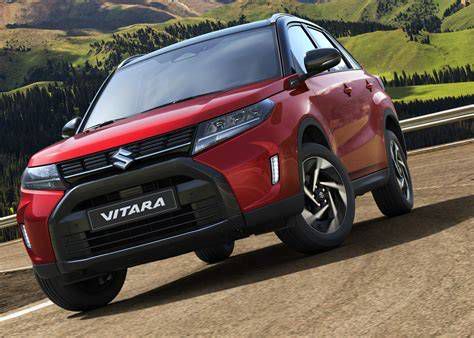
The new Vitara expresses Suzuki’s SUV styling heritage in a strong-looking design. Characterised by the Vitara’s bold styling, it aims at stealing the spotlight wherever you go. Defined by the Vitara’s authentic design, it is always on the lookout for on- and off-road discoveries. A clamshell bonnet, a hallmark of the Vitara series, gives the front end a look of solidity, and a trapezoid-motif front bumper indicates a powerful grip on the ground. Kicked-up body-side character lines and bonnet-side air outlets form motifs from the first-generation Vitara. Shoulder lines running the entire length of the body contribute to a look of SUV toughness. Suzuki’s pursuit of great aerodynamics is reflected in optimally designed bumper openings, in a roof line that slopes smoothly downward toward the rear, in flat underbody surfaces, and in side mirrors and front-bumper edges whose shapes are based on the results of airflow analysis. The vehicle now has a redesigned front fascia and upgraded tech. I find the car very attractive, muscle and bold looking with sleek full rail back light.
From the initial development stage, the model is designed with personalisation in mind. Diverse exterior colours and a range of design details enable owners to express their individual personalities. Each customer can choose from 15 body-colour possibilities that include three brand-new colours and several two-tone combinations. Atlantis Turquoise Pearl Metallic (ZQN) evokes the excitement and thrill of discovering natural beauty in highly urbanised cities. Some colour variants are just stunning. The urban package adds sophistication by means of chrome parts, while the rugged package emphasises SUV toughness.
Performance and Powertrain Options
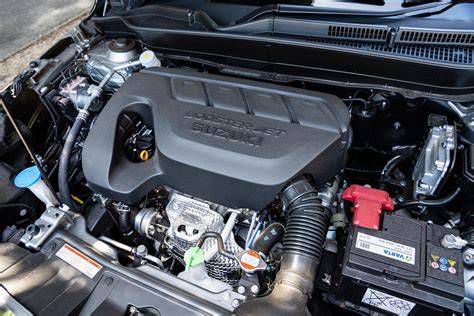
The Suzuki Vitara offers engines with decent performance, improved fuel economy for both petrol engines available, which include a mild hybrid and a full hybrid. Suzuki has also announced a fully electric Suzuki e Vitara, which will be an all-new model. The compact and lightweight strong hybrid system offers both fuel-efficient hybrid and EV driving. It consists of the 1.5 DUALJET engine, a Motor Generator Unit (MGU), AGS (Auto Gear Shift) and a power pack (140V lithium-ion battery and inverter). The highly efficient, high-output MGU enables EV driving by powering the vehicle alone and assists the engine to accelerate the vehicle. It also enables EV driving in reverse and fills in the torque gap while the clutch is disengaged for smoother shifting. When driving at a constant speed, the MGU utilises engine power to efficiently generate electricity that expands the EV driving range and frequency for high fuel efficiency and quiet driving. The 1.5-litre engine delivers high fuel efficiency, low emissions, strong output and torquey performance.
Engine Technology and Fuel Efficiency
Excellent fuel efficiency is achieved through various features. Dual fuel injectors are placed close to the intake valves and the compression ratio is raised for efficient fuel combustion. Combustion temperatures are lowered and pumping loss is reduced by the exhaust gas recirculation (EGR) system. Roller rocker arms are adopted to suppress friction loss. The 48V SHVS mild hybrid system consists of the 1.4 BOOSTERJET engine, a 48V ISG (Integrated Starter Generator) with electric motor function, 48V Lithium-ion battery and 48-12V DC/DC converter. With a greater supply voltage than conventional 12V, it increases both regenerated energy from deceleration and the amount of electric motor assist to suppress fuel consumption and enhance driving performance. The 1.4 BOOSTERJET direct-injection turbo engine enhances the torqueful driving of the Vitara. The intercooled turbocharger forces pressurised air into the cylinders and enables the engine to maximise torque in the low engine rev range, even at 2,000rpm. The direct injection system further enhances fuel efficiency by optimising control of the amount, timing and pressure of injected fuel in direct fuel injection. In addition, fuel efficiency is also raised by electric intake variable valve timing (VVT), cooled exhaust gas recirculation (EGR) and higher compression ratio. The new Vitara is powered by the M16 1.6-litre petrol engine or the D16AA 1.6-litre diesel engine. With the petrol option, friction reductions combine with weight savings in the engine and related components to realize superior fuel economy together with high output and torque. For the diesel engine, a new EGR system and an electronically controlled VGT help to realize powerful, torquey performance together with low emissions and superior fuel economy.
Our chosen engine for the Suzuki Vitara is a 1.4-litre petrol, which has mild-hybrid tech and comes with a slick six-speed manual gearbox that enables precise shifts. It's quite sprightly for a small SUV, nipping from 0-62mph in 9.5 seconds - slightly quicker than the entry-level Ford Puma and the equivalent VW T-Cross. While the mild-hybrid version can't drive on electricity alone, the regular hybrid can - but has less power, so it's slower to accelerate to 62mph, taking 12.7 seconds. That's not helped by its standard automated gearbox, which provides very slow gear changes. The Vitara comes with front-wheel drive as standard but can be upgraded to AllGrip four-wheel drive, although that adds weight and reduces straight-line performance. The new Vitara’s CO2 emissions are low thanks to the high-tensile steel and other weight-saving measures in the body and to an Engine Auto Stop Start system, which shuts down the engine when the car stops. The mild-hybrid engine brings good fuel economy, with an official WLTP figure of 53.2mpg (for the manual version). The regular hybrid Vitara can officially manage 56.4mpg. On a long drive, the vehicle returned close to 19 kms mileage. Vitara gives a mileage of 20-28km per litre. Mileage is good and features are just mind blowing.
ALLGRIP Select 4x4 System
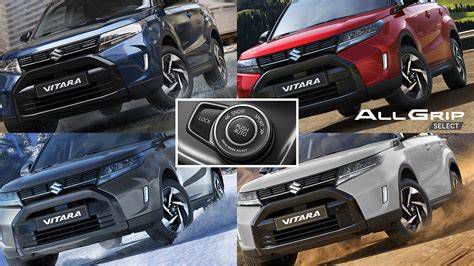
Equipped with ALLGRIP SELECT, Suzuki evolved its renowned four-wheel-drive technologies into a new generation that delivers driving pleasure and peace of mind in diverse conditions while promoting economy and limiting the burden four-wheel-drive cars place on the environment. An ALLGRIP system with four driver-selectable modes that permit safe, enjoyable driving on diverse surfaces debuted in the Suzuki SX4 S-CROSS and has since earned a great reputation. The new Vitara’s ALLGRIP system uses a feedback function to send more torque to the rear wheels if it detects wheelspin at the front. The new feed-forward function gives the system the additional ability to predict front-wheelspin risks from the road-surface condition, accelerator-pedal position, and steering angle and send more torque to the rear wheels before wheelspin occurs. The auto mode prioritizes fuel economy in typical driving conditions, using two-wheel drive by default. The sport mode is optimal for twisty roads, making maximal use of four-wheel drive in accordance with accelerator inputs and increasing cornering performance by allocating additional torque to the rear wheels. The snow mode is optimal for snowy, unpaved, and other slippery surfaces, using four-wheel drive by default. The lock mode is for extricating the car from snow, mud, or sand, delivering maximum torque to the rear wheels to get you out of sticky situations. Of course, the advantage of AllGrip is more traction and added confidence in slippery conditions. The only variant with the option of all-wheel drive, a rarity in compact SUVs.
Driving Dynamics and Comfort
The best way to describe the Vitara’s ride is "firm but well-damped." While big bumps and potholes send a dull thud through the interior, the car rarely gets unsettled and it never becomes jarring. Indeed, the Vitara isn’t uncomfortable to cover long distances in. When you head out on to a twisty road, the Vitara goes round corners well enough, but it's let down by the steering, which is very light when you begin to turn the wheel and gives little sense of connection to the front wheels. It’s better suited to town driving, helping you manoeuvre into parking spaces and around tight roundabouts with ease. The regular hybrid version is only 40kg heavier than the mild hybrid and the extra weight makes very little difference to how the car handles. All versions suffer from intrusive wind and road noise. The Vitara’s 1.4-litre engine is smooth enough even when worked hard but sounds tinny and noisy during moderate acceleration. The front wheels have MacPherson-strut suspensions. A revised shape for the lower arms, a revised layout for the suspension frame, and improved struts yield higher rigidity and accordingly better driving stability. The rear wheels have torsion-beam suspension with a beam design that Suzuki first adopted in the SX4 S-CROSS. The new Vitara has ventilated disc brakes at the front and solid disc brakes at the rear. Independent suspension at the front and rear enables good on-road stability at high speed and great off-road capability too. All-round ventilated disc brakes with fade resistance yielded by great cooling performance also enable the Grand Vitara to handle diverse surfaces. Overall driving experience was very good and comfortable, offering smooth driving dynamics and great handling.
Suzuki Vitara SUV 2018 review | Mat Watson Reviews
Interior Features and Practicality
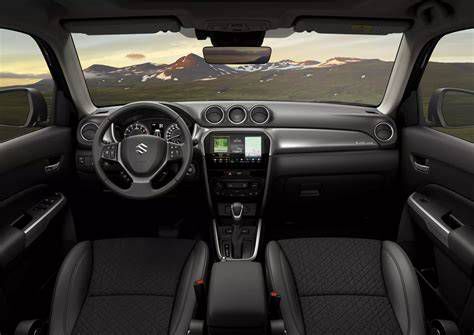
Getting into the Vitara is like entering a refined world full of high-quality materials. A boldly shaped instrument-panel garnish and a U-shape design around the shift lever communicate SUV toughness. Finding a suitable driving position in the Suzuki Vitara is simple because the driver’s seat and steering wheel can be moved up and down as well as forwards and backwards. You sit suitably high up too, making it feel more like an SUV from behind the wheel. The seat is quite comfortable. The gear lever in manual versions is high-set and relatively large so it falls easily to hand. Likewise, most of the controls are intelligently laid out, and the physical buttons and dials for the climate control make it easier to make adjustments while you're driving. The suede seat fabric and door inserts on Ultra models look and feel good too. While the Vitara isn't exactly plush inside, its interior does feel durable, and there are gloss-black plastics and patterned fascias to help break up the gloom. Seats are very much comfortable and made of different materials depending on the variant.
Technology and Connectivity
The 2025 Vitara's 9in touchscreen is bigger than on previous versions. It now has upgraded tech, including a bigger infotainment screen. An audio system with smartphone connectivity gives access to advanced navigation features (available with higher grades). We’d recommend using the standard Android Auto or Apple CarPlay smartphone mirroring to bypass Suzuki’s own software. The newly developed audio system has a seven-inch touch panel display with smartphone connectivity, enabling intuitive operation and usable by people wearing gloves. A three-dimensional navigation map makes landmarks easy to distinguish. Depending on the variant, features like a Head Up Display, TFT Instrument Console, and Wireless Charger are available. Remote AC On/Off is also a convenient feature.
Space and Comfort
The Vitara's SUV packaging combines generous minimum ground clearance of 185mm with big, 215/55R17 tyres. The Grand Vitara has a ground clearance of 210 mm. There’s enough room in the front for tall drivers, thanks in part to deep footwells. Plenty of leg room and a decent amount of head room are found in the two outer rear seats, even when the front seats are occupied by tall people. The middle seat is slightly raised so its occupant is more likely to struggle with head room. An adult can sit there, but shoulder room will be very tight if all three rear seats are filled. The panoramic glass roof that comes with Ultra trim might mean your hair brushes the roof for very tall passengers. Suzuki achieved a world first by equipping the SX4 S-CROSS with a sunroof consisting of two individually slideable glass panels. Now, the new Vitara incorporates the same acclaimed feature. The sunroof extends over the front and rear seats, making the cabin more relaxing for all occupants. When the sunroof is closed, the glass panels have a combined length of 1,000mm. The Grand Vitara has space for 5 people. Its fuel capacity is 45.0 L.
Boot Space and Flexibility
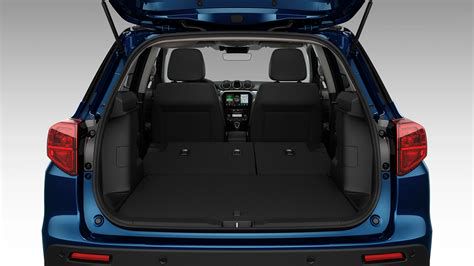
The mild-hybrid Suzuki Vitara's 362-litre boot is fairly big by the standards of small SUVs, and we managed to fit in five carry-on suitcases when we tested it. The regular hybrid has a smaller boot, with 289 litres, because the larger battery steals some of the storage space. In the mild-hybrid car's boot there's a useful underfloor storage area that's ideal for stowing valuables or loose items, plus two storage pockets (one on each side). If you drop the rear seats, they don’t fold completely flat, but there’s no awkward step in the extended boot floor to make life difficult when you're sliding in long, bulky items. It's easy to lower the backrests by pulling the levers at the top, and there's no need to faff about removing the rear headrests first. What's more, the backrests are light in weight so it’s no chore getting them back up again. The boot space of 265 - 373 litre with 60/40 functionality is enough to carry your things, luggages on a trip or vacation. My Grand Vitara has the tyre size of 17 r and the spare tyre is of the same size.
Advanced Safety and Driver Assistance Systems
The Vitara incorporates advanced safety equipment. The body embodies Suzuki’s Total Effective Control Technology (TECT) concept for occupant-protecting impact absorption and low weight. The new Vitara’s active-safety equipment includes the Radar Brake Support (RBS) system. If the probability of a collision has increased, the system activates brake assist which increases the braking force during panic braking. If the system determines that a collision is unavoidable, it applies the brakes automatically. The RBS system monitors the road ahead by means of milliwave radar, which enables it to work even at high speeds, in darkness, and in rain and other bad weather. The new Vitara’s ACC system combines cruise-control technology with the RBS system’s milliwave radar to make driving easier and more relaxing. Adaptive cruise control on the strong hybrid model features a stop & go function, accelerating and braking for the driver to maintain a safe distance from the vehicle in front. When in forward motion, the monocular camera and the laser sensor determine if there is a risk of collision with a vehicle or pedestrian. When driving at 65 km/h or faster, the monocular camera is used to recognise the driving lane. This system utilises the monocular camera to detect traffic signs, including speed limits, no passing zones, end of traffic regulation and auxiliary signs, and shows them on the multi-information display to remind the driver. When the indicator is turned on and there is a vehicle detected in a blind spot, the indicator will flash rapidly along with a warning sound to make lane changing safer. When backing out of a parking space, this function helps you avoid collisions. *There is a limit to the ability of cameras and sensors to detect obstacles, lanes and traffic signs. Please do not rely on these systems alone. Always drive safely.
Passive-safety equipment includes seven airbags, which protect occupants in the event of a frontal or side impact; seatbelt pretensioners and force limiters; and a mechanism that limits rearward movement of the brake pedal. Maruti Suzuki Grand Vitara comes with many safety features and has 6 airbags - two in the front, two on the side and two on the back. The Vitara was awarded five stars in its Euro NCAP safety tests back in 2015 but the rating has now expired. However, the Vitara gets loads of safety tech as standard, including automatic emergency braking (AEB), lane-departure warning, lane-keeping assistance, blind-spot monitoring and rear cross-traffic alert. Entry-level Motion trim includes a rear-view camera and rear parking sensors, with front parking sensors on the range-topping Ultra trim. A 360-degree view camera and Tyre Pressure Monitoring System (TPMS) are also available on higher variants.
Maruti Suzuki Grand Vitara: Key Variants and Specifications
The Maruti Suzuki Grand Vitara offers a comprehensive range of variants, each building upon the previous with enhanced features and technology. Below is a comparison of some key variants, highlighting their specifications and additional features.
| Variant / Price (Approx. Ex-showroom INR) | Transmission | Fuel Economy | Key Features |
|---|---|---|---|
| Rs.10,76,500 | Manual | 21.11 kmpl | Bi-Halogen Projector Headlamps, 6 Airbags, Rear Parking Sensors, Keyless Entry, Push Start/Stop Button, Auto AC, Rear AC Vents |
| Rs.12,09,700 | Manual | 21.11 kmpl | Adds: Reverse Parking Camera, Tyre Pressure Monitoring System, Cruise Control, 7-inch Touchscreen Infotainment, Electrically Foldable ORVMs |
| Rs.13,44,700 | Automatic | 20.58 kmpl | Adds: Electronic Parking Brake, Remote AC On/Off (features from previous Manual + Automatic transmission) |
| Rs.13,70,000 | Manual | 21.11 kmpl | Adds: LED Projector Headlamps, Auto Headlamps, 9-inch Infotainment, Ventilated Seats, Wireless Charger, Rear Door Sunshade |
| Rs.15,38,700 | Manual | 21.11 kmpl | Adds: Panoramic Sunroof, Head Up Display, 8-Way Driver Powered Seat, Leatherette Seats, 9-inch Infotainment, Ventilated Seats, 360 View Camera |
| Rs.18,15,100 | Automatic | 19.38 kmpl | Includes: ALLGRIP Select 4x4, Drive Modes, 8-Way Driver Powered Seat, Leatherette Seats, 9-inch Infotainment, Ventilated Seats, 360 View Camera |
| Rs.19,72,400 | Automatic | 27.97 kmpl | Includes: Panoramic Sunroof, Head Up Display, 8-Way Driver Powered Seat, Leatherette Seats, 9-inch Touchscreen Infotainment, Ventilated Seats, 360 View Camera (Strong Hybrid variant) |
| Rs.14,60,000 (CNG) | Manual | 26.6 km/kg | LED Projector Headlamps, Auto Headlamps, 9-inch Infotainment, Ventilated Seats, Wireless Charger, Rear Door Sunshade |
Ownership Experience and Reliability
The Suzuki Vitara is a relatively inexpensive car to run. Fuel efficiency and low maintenance cost are key factors for many owners. Normal servicing like oil change, airfilter cleaning and body check only cost 5000 to 7000 at max. The genuine spare parts of the vehicle are much less than the same parts of some competitors. Suzuki as a brand came a highly impressive third out of 31 car makers in our 2024 What Car? Reliability Survey - below Mini and Lexus but ahead of all other rivals ranked. The Vitara itself did reasonably well in the small SUV category of the survey, finishing in the top half of the table. As with many of its rivals, Suzuki gives you a three-year or 60,000-mile warranty as standard. However, as long as you continue to service your vehicle at an official centre, you’ll enjoy up to seven years or 100,000 miles of warranty. Many users strongly recommend this car, citing it as a great value for money in terms of performance, features and efficiency. It offers smooth driving dynamics and great handling, making it a comfortable and hassle-free car at minimal cost.