The Toyota Prius, renowned globally, has been a pioneering force in environmentally friendly vehicles since its introduction in 1997. Over five generations, it has consistently set new standards for fuel efficiency and low emissions. The revolution of eco-friendly cars began with the introduction of the Toyota Prius Hybrid in 2000, making it the world's first mass-produced petrol-electric hybrid car launched in many global markets. Today, the Toyota Prius Hybrid offers an eco-friendly driving experience that combines reduced emissions with excellent fuel economy and lower operating costs compared to traditional vehicles. Toyota was also the first company to offer the world PHV (Plug-in Hybrid Vehicle) technology, further solidifying its commitment to sustainable mobility.
The Heart of Efficiency: Hybrid Synergy Drive (HSD)
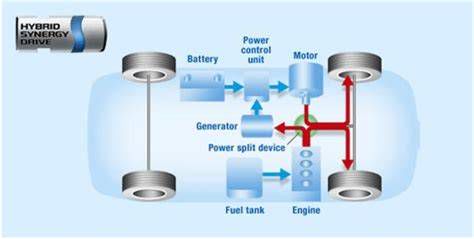
At its core, the Toyota Prius features a sophisticated hybrid drivetrain known as Hybrid Synergy Drive (HSD). This system seamlessly combines an efficient gasoline engine with one or more electric motors, powered by an advanced battery. The Prius operates as a power-split or series-parallel (full) hybrid, capable of being propelled by petrol, electric power, or both, ensuring optimal performance and energy savings.
The system can operate solely on the electric motor at low speeds or integrate both engines as needed, guaranteeing energy savings and reduced emissions. One of the notable features of the standard Toyota Prius Hybrid (non-PHEV) is that it does not need to be plugged into an external power source to recharge the battery, as it self-charges through regenerative braking and the gasoline engine.
Plug-in Hybrid (PHV) Advancements
Toyota has also introduced versions of the Prius hybrid that can be charged (Plug-in), allowing charging from an external power source and driving longer distances on electric power alone, while retaining the flexibility of the gasoline engine for long trips. The second generation Prius Plug-in Hybrid represents a significant evolution, featuring numerous sophisticated technological breakthroughs.
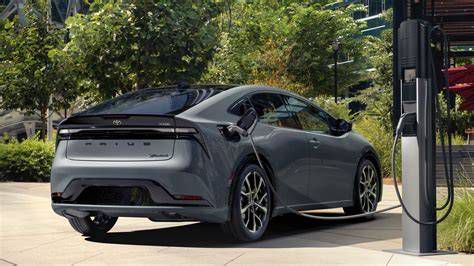
These include two Toyota firsts: a Battery Warming System and a Dual Motor EV drive system, and two world firsts: an EV range-extending solar roof and gas injection heat pump air-conditioning. With an EV range more than doubled to over 50 km and maximum EV speed increased from 85 to 135 km/h, the new Prius Plug-in Hybrid represents a huge leap forwards in efficiency, driving performance, innovation, and styling.
The Prius Plug-in Hybrid has an up to 44-mile EPA-estimated all-electric driving range rating with a fully charged battery, offering a nearly emission-free driving experience for short city trips, with the flexibility to rely on the gasoline engine for long journeys.
Battery Technology and Charging
The significant increase in EV driving range, from 25 km to over 50 km in the PHV, is based on technological improvements in three key areas: optimum battery development, maximizing EV driving performance, and making the overall vehicle package much more efficient. Located under the rear load space, a large capacity lithium-ion battery is fundamental to the new Toyota PHV’s more than doubled EV range of over 50 km. The battery capacity has equally doubled from 4.4 to 8.8 kWh. Yet, the battery volume has only increased by 66% (from 87 to 145 litres), and, at 120 kg, it is only 50% heavier than its predecessor.
There are two batteries in the Prius: the high voltage (HV) battery pack, also known as the traction battery, and a 12-volt battery known as the low voltage (LV) battery. The traction battery of the first generation Prius update (2000 onwards) was a sealed 38-module nickel metal hydride (NiMH) battery pack with a capacity of 1.78 kWh at a voltage of 273.6 V, and weighing 53.3 kg. The Second Generation Prius contains a 1.31 kWh NiMH battery, composed of 28 modules. These batteries are normally charged between 40 and 60% of maximum capacity to prolong battery life as well as allow headroom for regenerative braking.
For the Plug-in Hybrid, maximum charging power increased from 2 to 3.3 kW, allowing the battery to be fully charged up to 65% more quickly; in only 2 hours using the Type II Mode III Mennekes connector, and 3 hours and 10 minutes using a standard household plug socket. The charging process is now programmable weekly on a day-by-day basis, and includes the facility to simultaneously charge and pre-cool or pre-heat the cabin.
Here's a comparison of battery specifications across different Prius models:
| Prius Model / Generation | Battery Type | Capacity (kWh) | Weight (kg) |
|---|---|---|---|
| 1st Gen (2000 onwards) | NiMH | 1.78 | 53.3 |
| 2nd Gen | NiMH | 1.31 | - |
| New PHV (Plug-in Hybrid) | Li-ion | 8.8 (from 4.4) | 120 (from 80) |
Advanced Thermal Management and Dual Motor Drive
The further minimizing of engine usage whilst the Prius Plug-in Hybrid is operating in EV drive mode is assured through the enhanced efficiency of the new PHV system. EV power has been increased by some 83% thanks to the development of Toyota’s first hybrid powertrain to feature a Dual Motor Drive System. A new, highly-compact one-way gear within the transaxle allows the hybrid system generator to act as a second electric motor, boosting EV driving power for better acceleration, a more engaging performance, and a maximum EV driving speed of 135 km/h, whilst greatly reducing engine start up frequency.
The air-conditioning is now powered by a gas-injection heat pump - a world first technology - which will heat the cabin in outside temperatures as low as -10 degrees C, without starting the engine, hence minimizing the impact which heating the interior has on both fuel consumption and EV driving range. Moreover, during charging, a new battery warming system will warm the cells to an efficient working temperature in outside conditions as cold as -20 degrees C. This ensures that both battery power and efficiency are maintained at a sufficient level to minimize the impact of cold weather on EV driving range.
Fully Tested: Toyota Prius Plug-in Hybrid
Dynamic Performance and Driving Experience
The latest generation Prius, with its modern look and dynamic feel, is designed to perform. Previously known as a dorky-looking, joyless commuter car, the latest Prius has made huge strides in shedding its old image. It looks sleek, handles well, accelerates quickly, and gets up to 57 mpg combined, proving that efficiency doesn’t mean compromising on driving pleasure.
Engine and Drivetrain
The fifth-generation Prius offers hybrid powertrains featuring a 2.0-liter inline-four gasoline engine combined with two electric motors for Front-Wheel Drive (FWD) models, delivering 194 horsepower. For All-Wheel Drive (AWD) Priuses, Toyota adds a permanent-magnet electric motor to the rear axle, bumping total powertrain output to 196 horsepower. This enables the Prius to accelerate from 0-60 mph in 7.2 seconds with FWD and 7.0 seconds with AWD.
With a total power output of 90 kW, the new PHV’s full hybrid powertrain combines improved EV and HV driving performance to accelerate the Prius Plug-in Hybrid from 0-100 km/h in 11.1 seconds, and on to a top speed of 162 km/h. Its continuously variable automatic (CVT) transmission ensures a seamless power delivery.
Fuel Efficiency and Emissions
The Prius’ Hybrid Synergy Drive® system continues to deliver great efficiency. Per the EPA, the base, front-drive Prius LE is good for 57 mpg in the city and 56 mpg on the highway; all-wheel drive drops those figures to 53 and 54 mpg, respectively. XLE and Limited models, possibly due to larger, heavier wheels and tires, are EPA-rated at 52 mpg in both city and highway with FWD and 49 mpg city and 50 mpg highway with AWD. The Prius Plug-in Hybrid achieves average fuel consumption of only 1.0 l/100 km and CO2 emissions of just 22 g/km.
Driving Modes and Controls
Toyota introduced user-selectable driving modes to enhance the driving experience. A choice of four switchable powertrain modes is available: HV Mode, EV Mode, EV City, and a new Battery Charge Mode. HV Mode efficiently combines the power delivery of the engine and electric motors. EV Mode primarily uses electric power from the HV battery, allowing for electric-only low-speed operation (under 25 mph or 40 km/h) for short distances with low noise and no fuel consumption. The EV City Mode further reduces maximum power output to keep the vehicle on electric power alone for as long as possible. The new Battery Charge Mode uses the engine to generate electricity to charge the battery while driving in HV Mode.
Additionally, three ‘on-demand’ Drive Modes - NORMAL, POWER, and ECO - may be selected to further increase driving efficiency, performance, and fuel economy. The POWER mode modifies the response to throttle inputs for improved acceleration, benefiting from the automatic activation of a new DMD (Driver’s Mind D Logic) drive assist system for a more responsive driving experience. In ECO mode, throttle response is reduced, and air-conditioning control is optimized for improved fuel economy, supporting environmentally-friendly driving techniques.
Responsive Handling and Ride Comfort

The Toyota New Global Architecture (TNGA)-based platform plays a defining role in the Plug-in Hybrid’s rewarding driving experience. This platform provides greater rigidity, a lower center of gravity, and secures a more engaging driving position with more precise and responsive handling and less body roll. The body is 60% more rigid than that of its predecessor, thanks to extensive use of high-strength steels and structural adhesives.
Driving dynamics are further enhanced by model-specific settings to the Prius Plug-in Hybrid’s MacPherson strut front and new double wishbone rear suspension, combining high quality ride comfort with greater handling stability. The front stabilizer bar has also been enlarged over that of the fourth generation Prius, resulting in a 13% reduction in roll rate for even greater handling stability.
Cabin Quietness (NVH)
A particular focus has been placed on minimizing NVH (Noise, Vibration, and Harshness), complementing the innate quietness inherent in the extended EV mode of the new Toyota PHV. The optimum placement of sound suppressing and absorbing materials offers occupants unique levels of cabin quietness. Specific NVH-reducing measures include bonnet side seals, urethane fender separators, acoustic front door glass, rear wheel housing inner silencers, a urethane-based headliner, and enlarged floor silencers, ensuring a serene driving environment.
Striking Aerodynamic Design
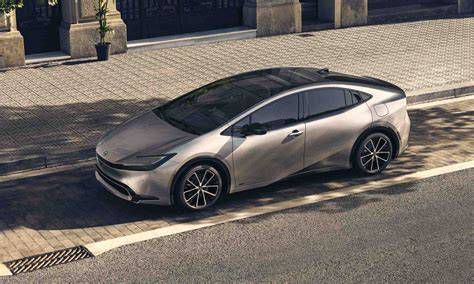
The new Prius Plug-in Hybrid’s striking, highly aerodynamic design builds on the iconic Prius profile with unique styling elements that hint at the advanced technology within. It features unique, stand-alone aerodynamic styling for a class-leading drag coefficient of only Cd 0.25 (compared to Cd=0.29 for the 2000 model). This remarkably low drag coefficient is key to achieving significant fuel consumption benefits.
At 4,645 mm long, 1,760 mm wide, and 1,470 mm high, the new Toyota PHV is longer, wider, and lower than its predecessor, with lengthened front and rear overhangs. The front of the new Prius Plug-in Hybrid is instantly recognizable through a highly three-dimensional acrylic grille treatment and thin, ultra-compact 4-LED headlamp units featuring new adaptive technology. The vertical location of the Daytime Running Lights (DRL) and LED turn indicators at the extreme edges of the front fenders reinforce the low, wide, ground-hugging stance of the vehicle.
In profile, PHV-specific, two-tone 15” alloy wheels are designed to enhance brake cooling. To the rear, the PHV-unique, aerodynamics-enhancing, ‘double-bubble’ rear screen is carried into the curve of the rear spoiler, at the extremities of which are integrated rear LED light clusters. The new Toyota PHV also features a shutter built into the lower front grille, which automatically opens or closes to optimize the flow of cooling air into the engine bay, further reducing air resistance. For aesthetic enhancements, the Nightshade Edition offers 19-in. wheels and black exterior trim pieces.
Interior Comfort and Connectivity
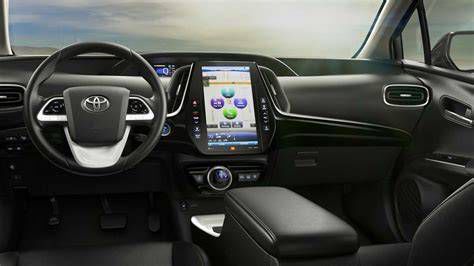
Inside, the Prius focuses on elevating comfort and style. The rear seats feature a 60/40 split-fold design, allowing for adaptability and maximizing cargo space. Opening the rear hatch reveals ample cargo room, with the LE model accommodating 23.8 cubic feet of storage behind its rear seats, and upper trims offering 20.3 cubic feet.
Advanced Infotainment and Driver Assistance
The Prius boasts advanced technology that makes driving easier and instills more confidence. An 8.0-inch infotainment screen comes standard on LE and XLE models, while Toyota uses a massive 12.3-inch touchscreen on the Limited (or as optional equipment for the XLE). This system includes "Hey, Toyota" voice control, receives over-the-air updates, and offers Bluetooth, wireless Apple CarPlay, and Android Auto compatibility. Audio systems include a standard 6-speaker stereo and an optional 8-speaker JBL stereo.
From helping you get into that perfect parking spot with available Advanced Park, to getting you through controlled access freeways traffic with Traffic Jam Assist (TJA), the Prius Plug-in Hybrid has technology that makes driving easier. Traffic Jam Assist requires an active Drive Connect trial or subscription, with a 1-year trial subscription included on select grades.
For the first time, the Prius now has a gauge cluster facing the driver directly in front of the steering wheel. Additionally, dedicated electric drive motors automatically provide power to the rear wheels when Prius’ available Electronic On-Demand All-Wheel Drive (AWD) senses slipping, offering peace of mind in less than perfect weather conditions. Toyota's lineup brings you more than just your choice of electrified powertrains: Hybrid EV, Plug-in Hybrid EV, Battery EV, and Fuel Cell EV.
Generational Evolution and Market Impact
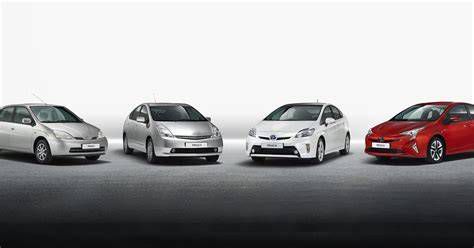
The Toyota Prius has evolved significantly over five generations since 1997. The first-generation Prius NHW11 was the first Prius sold by Toyota outside of Japan, with sales beginning in the year 2000. In 2003, the NHW20 Prius was a complete redesign, becoming a compact liftback sized between the Corolla and Camry, significantly increasing rear-seat legroom and luggage room.
The third-generation Prius (2010 US model year) debuted in 2009, featuring a reduced drag coefficient of Cd=0.25 and new standard driving modes. The fourth-generation Prius, released in 2015, was the first to use the Toyota New Global Architecture (TNGA) modular platform, providing a lower center of gravity and increased structural rigidity. In 2021, the Nightshade Edition was released in the US, adding black exterior trim pieces.
The fifth-generation Prius was presented in 2022, offering 1.8-litre and 2.0-litre variants with higher power outputs and available E-Four all-wheel drive. In the Canadian market, Toyota exclusively offers the electronic on-demand all-wheel-drive (E-Four) system across all trims to better suit harsh winter conditions.
Expanding the Prius Family
In 2011, Toyota expanded the Prius family to include the Prius v (also known as the Prius α, and Prius+ in several markets), an MPV, and the Prius c (also known as the Aqua), a subcompact hatchback. The Prius α in Japan was available in five-seat, two-row and seven-seat, three-row models, with the latter utilizing a space-saving lithium-ion drive battery. The Prius v, launched in North America, came with a nickel-metal hydride battery pack and two rows of seats for five passengers.
Toyota continues to develop Prius hybrid models to make them more advanced, improving battery performance, increasing fuel efficiency, and providing advanced safety and comfort technologies. The brand also focuses on reducing whole fleet CO2 emissions by 90% by 2050 through the use of HV, PHV, EV, and FCV technologies, further solidifying its commitment to eco-friendly vehicles.
Environmental Commitment and Materials
Toyota’s commitment to sustainability extends to the materials used in the Prius. The vehicle incorporates a range of plant-derived ecological bioplastics, utilizing wood or grass-derived cellulose instead of petroleum. Key crops used include kenaf, a member of the hibiscus family, and ramie, commonly known as China grass, which is one of the strongest natural fibers. This eco-conscious approach reflects Toyota’s goal of creating the ultimate eco car.
Market Presence and Ownership Benefits
The Toyota Prius has achieved remarkable success globally. Cumulative Prius sales in Europe reached 200,000 units by mid-2010. In Japan, the Prius liftback was the top-selling new car for 16 months in a row until September 2012, and the best-selling car for four consecutive years in 2012. In the US, high petrol prices contributed to record monthly and quarterly sales for Prius family vehicles in 2012, with a total of 223,905 Priuses sold that year. Since their inception in 1999, over 1.5 million Prius family members have been sold in the US by mid-October 2013, representing a 50.1% market share of total hybrid sales in the country. Depending on your location, you may also be eligible for EV rebates, incentives, or benefits for owning a Prius.
Warranty Information
Toyota provides comprehensive warranty coverage for the Prius, reflecting confidence in its technology and durability:
- Limited Warranty: three years or 36,000 miles
- Powertrain Warranty: five years or 60,000 miles
- Hybrid-Component Warranty: 10 years or 150,000 miles
- Complimentary Maintenance: two years or 25,000 miles